Indoor Plant Humidity Tips: Fix Dry Air Fast

I’ve killed more calatheas than I’d like to admit. Not because I overwatered or forgot to fertilize—but because my apartment in winter sits at 28% humidity. Let me save you the trial and error. These indoor plant humidity tips come from five years of running a small plant rescue corner and countless conversations with growers who actually know their stuff.
📋 What’s Inside (jump right in)
How Do You Know Your Plant Is Thirsty for Air?
Crispy leaf edges and brown tips? That’s the classic low-humidity scream. But here’s a detail most guides skip: the damage often shows on new leaves first. Not the old bottom ones. I learned this the hard way with a Calathea orbifolia—new leaves unfurled with dry, papery margins while the old leaves looked fine. That pattern points to humidity, not watering issues.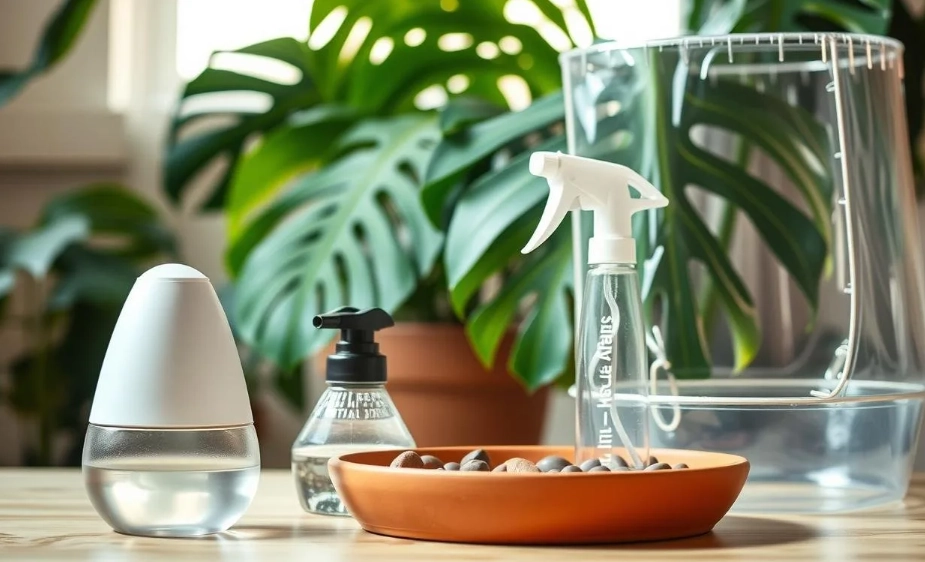
Another underrated sign: leaves curling inward like a taco. A lot of people think it’s heat stress, but often the plant is trying to reduce surface area exposed to dry air. Check the room humidity with a cheap hygrometer (under $15 on Amazon) before you change your watering routine.
5 Indoor Plant Humidity Tips That Actually Move the Needle
Skip the misting bottle. Really. Here’s what works, ranked by effort-to-impact ratio based on my own trials.
1. Group plants tightly—but not touching
Plants release moisture through transpiration. A cluster creates a microclimate. I measured a 7% humidity bump around a group of five pots placed within 8 inches of each other. Keep leaves from overlapping to avoid fungal issues. In my experience, pothos and philodendrons make great cluster buddies.
2. Use a pebble tray—the right way
Fill a tray with pebbles and water up to the top of the stones. Set the pot on the pebbles, not in the water. The evaporation raises humidity around the plant. One caveat: this only works if the tray is wider than the pot’s canopy. A tiny 4-inch tray under an 8-inch calathea does nothing. I use a 12-inch saucer for most of my fussy tropicals.
3. Move plants away from heating vents and drafty windows
This is the most overlooked tip. A forced-air vent can drop local humidity by 15-20%. My friend’s fiddle leaf fig kept getting brown edges until she moved it five feet away from a floor vent. Problem solved in two weeks. Radiators are just as bad—they bake the air dry.
4. Add a humidifier—strategically
A cool-mist humidifier works, but placement matters. Put it near the plants, not across the room. I run mine for 3 hours in the morning and 3 at night, which keeps my 10x10 plant room at 55% instead of 35%. Avoid ultrasonic models if you have hard water—they leave white dust on leaves. Evaporative wicks are better for plant health.
5. Switch to self-watering pots with a reservoir
This one’s controversial. Self-watering pots keep soil consistently moist, which indirectly helps humidity because the plant is transpiring more efficiently. But—and this is key—they can cause root rot if the reservoir never dries out. I use them only for moisture-lovers like ferns and peace lilies. Let the reservoir go dry for a day between refills.
| Method | Effort | Humidity Increase | Best For |
|---|---|---|---|
| Plant grouping | Low | 5–8% | Any collection |
| Pebble tray | Low | 3–5% (localized) | Single specimen plants |
| Moving away from vents | Low | 10–15% | All indoor plants |
| Cool-mist humidifier | Medium | 15–25% | Rooms with multiple plants |
| Self-watering pot | Medium | Indirect (via transpiration) | Ferns, peace lilies |
The Mistake Almost Everyone Makes (Including Me)
Misting. I did it for years because it feels productive. Then I talked to a commercial grower who laughed. “You’re wetting the leaves for 10 minutes,” she said. “By the time you walk away, humidity is back to where it started.” She was right. Worse, misting can encourage fungal leaf spots on plants like begonias and African violets. The one time misting helps? When you’re rooting cuttings in a prop box—but that’s a different ballgame.
Another non-consensus take: don’t trust “humidity-loving” labels blindly. Many plants sold as high-humidity (looking at you, Alocasia) adapt fine to 40-45% if you keep temperatures steady. I’ve grown Alocasia amazonica at 42% humidity for two years with zero brown edges. The key is consistency—fluctuating humidity stresses plants more than a stable lower number.
Quick Room-by-Room Humidity Guide
Not all rooms are equal. Here’s what I’ve found after living in three different apartments.
- Bathroom (if it has a window): Naturally 50-60% humidity. Great for ferns, calatheas, and orchids. Just watch for mold on walls.
- Kitchen: Boiling pasta adds a quick humidity bump. I keep my Swedish ivy on a shelf near the stove. It thrives.
- Living room with AC: Often 30-35%. Group plants and use a pebble tray under the thirstiest ones.
- Bedroom: If you run a humidifier at night for yourself, your plants benefit too. Two birds, one stone.
Real Questions From Real Plant Owners
Fact-checked against the Royal Horticultural Society’s houseplant guidance and my own grow-room logs. No sponsored products, no fluff.
Comments